
Powered by Readium · Muhammed Salah on building digital bridges between publishers and readers
A few weeks ago, we met with Muhammed Salah, Digital Products Manager at Samawy, to discuss the company's vision and ambitions. We focused on the way that Samawy channels Readium technologies in both their user-facing platform and their internal ebook production pipeline.
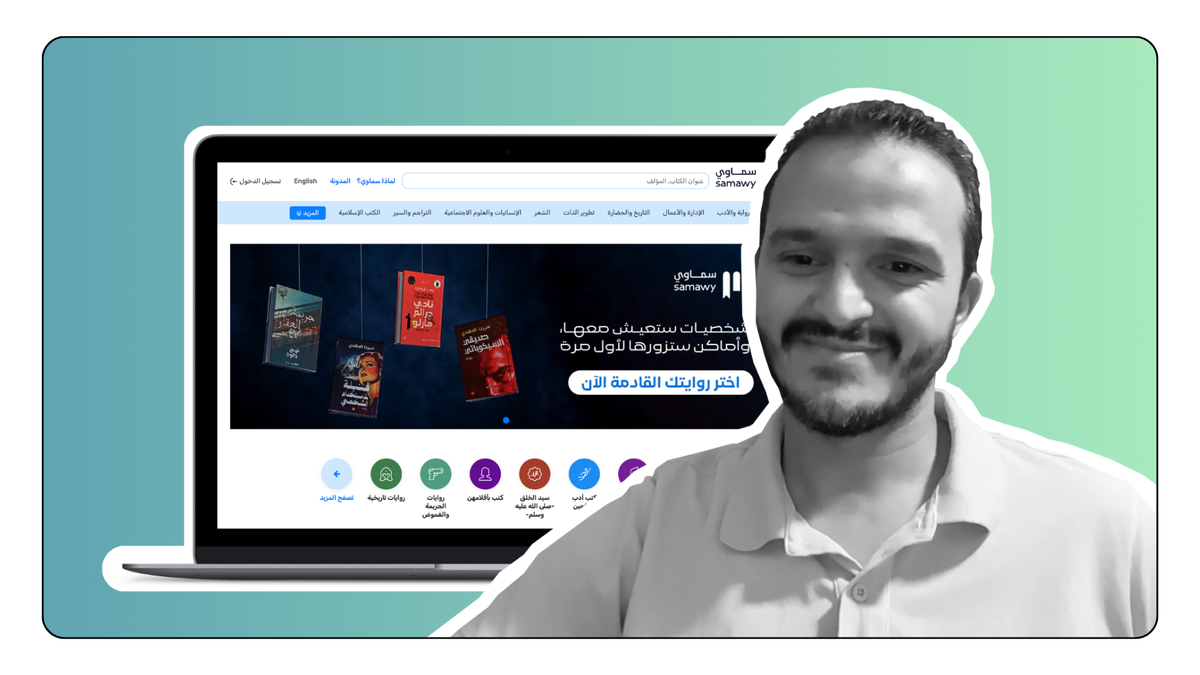
Samawy is an Arab digital publishing platform. Since its creation in 2022, the company has worked to provide best-in-class digital solutions to publishers and readers across the Arab world. Nowadays, it caters to every player in the book industry, ensuring new opportunities for them to create, connect and inspire readers throughout the world. Watch our full interview with Muhammed Salah below and discover its key takeaways in this article. Enjoy your read!
Building the digital infrastructure for reading and publishing in the Arab world
Samawy started out as a print-on-demand service for publishers, an origin that truly shaped the company since it gave them a unique perspective into their clients’ issues: unpaid royalties, missing files, incomplete metadata… Samawy built the basic infrastructure that Arabic publishing needs to achieve their goals: production, metadata, distribution and a smooth and accessible reading experience for readers.
From metadata issues to digital piracy, overcoming the obstacles to digital publishing
In 2025 and 2026, Muhammed took the floor during the Digital Publishing Summit (DPS) to talk about the obstacles that Samawy encounters when working on digital infrastructures in the Arab market. Although the company sometimes has to overcome issues that are common in the digital publishing sector, some are very particular to their region.
The first and biggest issue in the Arab market according to Muhammed Salah is the problem they have regarding metadata. It is not uncommon for Arabic books to come out with no subject categories, author names spelled several different ways, or sharing the same ISBN as another book. Another issue is the fact that a huge share of Arabic books exist only in print and in or only as a scanned PDF. Arabic OCR is still weaker than the English OCR, mostly because the technology providers don't account for Arabic as a primary language. Finally, there is trust. Digital piracy is a significant problem in the Arab world, and it especially harms publishers, authors and the wider cultural scene. As a result, many publishers simply refuse to release digital rights for their books. It took many years and a lot of research for Samawy to rebuild that trust by developing technologies that accept this reality instead of rejecting it at all cost.
“We don't blame them. You can't lecture someone out of a fear that's based on real losses they have encountered. Some publishers have lost millions of Egyptian pounds or Saudi riyals because of leaks, so we have to show them protection.”
Channeling Readium technologies to bridge the gap between authors, publishers and readers
When Samawy first became acquainted with Readium and EDRLab’s technologies, their main goal was to test as many toolkits and implementations as possible. They immediately saw the benefits of choosing a solid standards-based foundation that allowed them to put their limited energy into the problems that were specific to their area. For example, Samawy uses the Kotlin toolkit in its Android app and the Swift toolkit in its iOS app. They also protect ebooks and audiobooks in their mobile apps using LCP DRM, and created an e-reader for samples on their website using Readium Web.
In parallel to those user-facing platforms, Samawy uses Readium CLI and Readium Web as a testing environment for their internal ebook production pipeline, which produces more than 1000 to 1500 books monthly. Finally, they integrated the Qualebook framework into the pipeline to ensure that all quality checks are standardized. Beyond the stable foundation they provided, Readium toolkits offer many aspects that were extremely important to Samawy, for example the right to left support, which most reading frameworks are missing. Another one, of course, is Readium LCP content protection. Finally, the last reason why Samawy chose Readium is the community it fosters.
“We are not speaking about a vendor. We are speaking about a community. We can humbly say that our capacity is limited. Our energy is limited. We are not a big company that has a very big number of developers […] so we rely a lot on the community of Readium.”
From consumers to contributors, the future of Samawy, EDRLab and Readium’s partnership
Right now, Samawy’s ambition is to move from consumer to overall contributor. They are already working hand in hand with EDRLab work on the first out of Europe version of Qualebook manuals and framework. In the current phase of the project, they are localizing the Qualebook framework to start making it adaptable to the Arabic challenges and available for all Arab publishers and stakeholders.
In parallel, Samawy also works on its own internal projects, mailing the applications of AI on the Arabic publishing problems, especially metadata, OCR, classification and enrichment of the content. These issues are the backbone of their most recent initiative, Samawy AI Lab, which will be announced at the end of the year.
Creating the supply of ebooks to satisfy an often overlooked demand
By the end of our interview, Muhammed emphasized that there is a largely believed misconception that there the Arab world has a low demand for ebooks. However, in his own experience, Muhammed found that once the book supply is fixed and created in good quality and quantity, there is a large population of readers to consume them.
In Muhammed's opinion, the current pessimism about the Arab market says more about what it has offered to readers than about the readers themselves. The issue lies in the supply, the infrastructure and the tissue connecting the stakeholders in the field. The Arab world has a rich reading culture, an insatiable reading appetite and millions of readers searching for books that Samawy works to provide.
Millions of readers search for books and visit our book fairs yearly. […] The Arab publishing industry needs support, enhancement, cooperation and coopetition to create better value for the users, who are very keen on reading and knowledge and books.


